
The other day, I met with a friend and trusted advisor to talk about the work of Groundswell Saint Louis. I wanted his perspective and counsel on where we’re headed.
As I explained what we’re doing, he stopped me.
“Before we go any further,” he said, “tell me again: what’s the vision? It sounds like Perspectives isn’t the goal for you—it’s a tool. So what’s the end goal?”
I paused, gathered my thoughts, and started over.
Ultimately, the vision is to see the Church across Greater St. Louis labor together in the gospel—across political, geographic, racial, and denominational lines—with eyes fixed not only on our city but also on the completion of the Great Commission among every tribe, tongue, and nation.
I probably didn’t say it quite that clearly in the moment, but his response was immediate.
“Wow,” he said. “That’s really big. Shouldn’t you start smaller?”
He pointed to several thriving ministries we both admire and noted that most of them began with a narrow, specific focus rather than a sweeping regional vision.
I’ve been wrestling with that conversation ever since.
After all, how can one person—or even one organization—possibly have that kind of influence in a metropolitan area of nearly three million people?
Then my friend offered another observation that has stayed with me.
He suggested that while many Christians in Greater St. Louis faithfully attend church, relatively few are actually living as disciples of Jesus.
I think that’s a fair challenge. But it immediately raises another question:
What does it actually mean to be a disciple?
In Matthew 28:18–20, Jesus commands His followers to “go and make disciples…teaching them to obey everything I have commanded you.”
A disciple, then, is more than someone who believes certain truths. A disciple is someone who is learning to obey Jesus in every area of life.
And here’s the fascinating part: one of the commands Jesus gave was to make disciples.
In other words, disciples make disciples who make disciples.
That’s worth sitting with.
Is that how we think about our own lives?
Too often, when Christians hear the words “make disciples,” we translate them as “share the gospel” or “do evangelism.” While sharing the good news is essential, Jesus’ command doesn’t stop there. He didn’t simply tell us to make converts; He told us to teach people to obey everything He commanded.
Discipleship is not a one-time transaction. It isn’t a single decision, a completed class, or a spiritual milestone that we eventually graduate from.
It is the lifelong process of becoming more like Jesus.
None of us has finished that journey.
Sharing the plan of salvation with a friend is a beautiful beginning, but it isn’t the finish line. Jesus calls us into something much deeper.
There’s another aspect of discipleship that we often miss because we’re separated from the cultural world of first-century Judaism.
When a rabbi invited someone to become his disciple, it wasn’t an invitation to add another activity to an already busy schedule.
It was an invitation to leave behind ordinary life and immerse oneself in the life of the rabbi—to go where he went, do what he did, learn how he lived, and gradually become like him.
Discipleship wasn’t something you fit into your calendar.
It became the organizing center of your life.
That’s exactly the kind of invitation Jesus extends.
He doesn’t ask us to pencil Him in between work meetings and weekend commitments. He calls us to take up our cross, follow Him, and allow our relationship with Him to reshape every part of who we are.
Jesus doesn’t invite us into half-measures.
I’ll be honest: I left that meeting discouraged.
The advice I had hoped to receive wasn’t the advice I got, and for a while I found myself questioning whether the vision I’ve been pursuing over the last several years was simply too ambitious.
But later that evening, Jesus had a surprise in store for me.
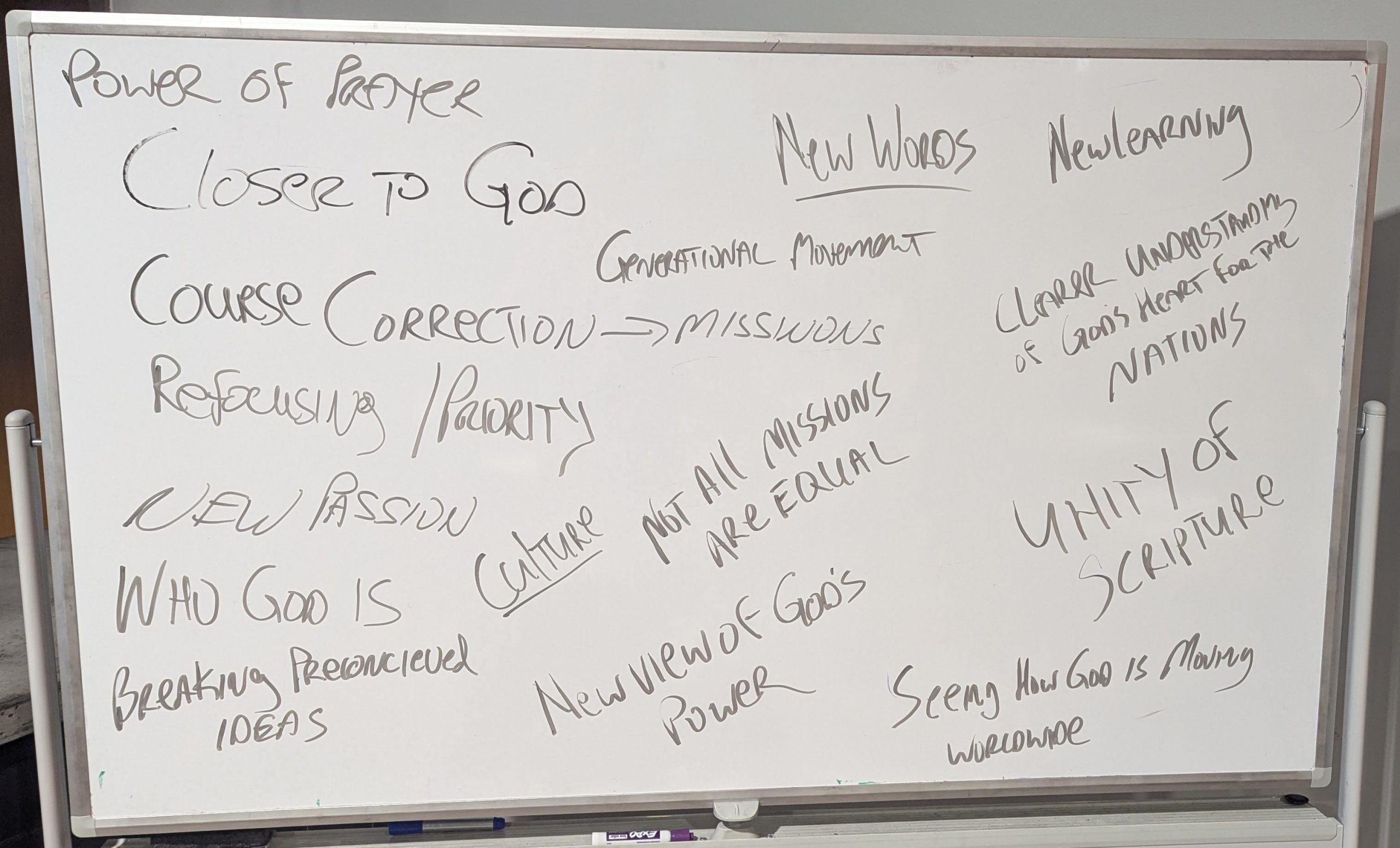
I gathered with a team of volunteers preparing to host a Perspectives on the World Christian Movement course this coming spring. It was our very first planning meeting.
Prompted by the Holy Spirit, I asked a simple question:
“Why is Perspectives worth your time?”
Every person in the room had completed the course before. Many had volunteered multiple times.
One after another, they began sharing their stories.
- “It drew me closer to the heart of God.”
- “I discovered the power of prayer in a completely new way.”
- “I have a bigger view of God’s power.”
- “I understand Scripture—and the unity of Scripture—in ways I never had before.”
The stories kept coming, faster than I could write them down.
What struck me wasn’t simply that they had enjoyed a class.
It was that they were describing lives transformed through discipleship.
Again and again, people spoke about discovering God’s heart, finding renewed purpose, reorienting their lives around His mission, and continuing to live differently years after the course had ended.
It felt like God was answering the discouragement I’d carried into the room.
Yes, many Christians today struggle to embrace the fullness of discipleship.
But sitting in front of me was a diverse group of believers from multiple churches who had experienced profound spiritual transformation through fifteen weeks of intentionally engaging Scripture, God’s global mission, and His heart for the nations.
That doesn’t mean a classroom is the end goal.
It never has been.
The goal is disciples.
The classroom is simply one pathway that God has repeatedly used to awaken them.
Will every person today respond to Jesus the same way first-century disciples responded to a rabbi? Probably not.
Most people aren’t prepared to leave everything overnight, and many already feel overwhelmed by the pace of modern life.
But perhaps God, in His wisdom, often meets us through familiar rhythms.
For many people, that rhythm is a classroom.
What if, for fifteen weeks, you simply became curious about the heart of God?
What if you allowed Scripture to challenge your assumptions, expand your vision, and deepen your understanding of His mission?
You might discover that what begins as a course becomes something much more.
It just might become the next step in your journey of following Jesus.