
On December 7, 1941, aircraft from the Imperial Japanese Navy launched a surprise attack on Pearl Harbor, aiming to cripple the United States Pacific Fleet in a single blow. In the 1970 film Tora! Tora! Tora!, Japanese Admiral Isoroku Yamamoto reflects on the moment with a haunting line: “I fear all we have done is to awaken a sleeping giant and fill him with a terrible resolve.”
History turns on moments like that—moments when something dormant is stirred, and nothing is ever the same again.
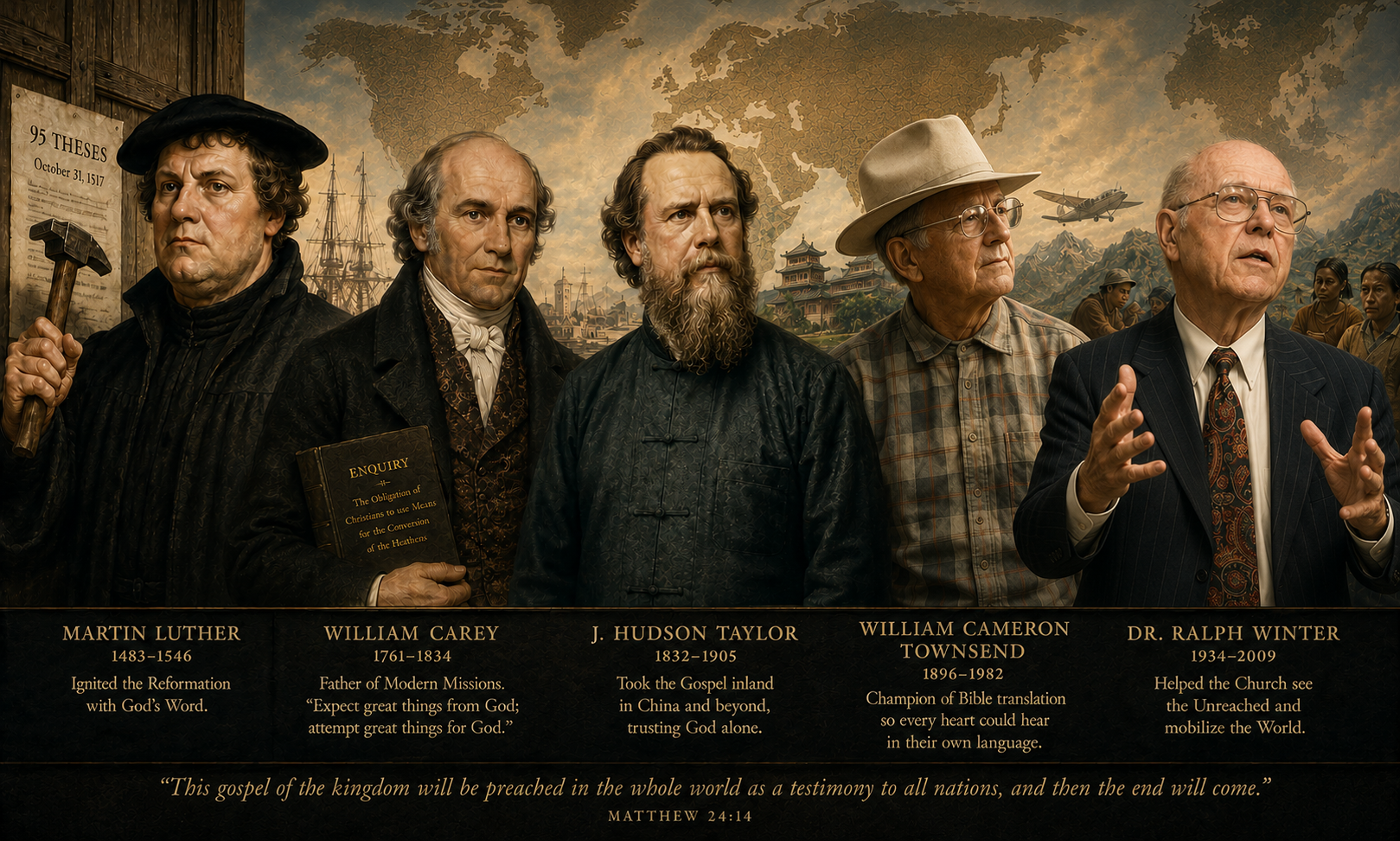
On October 31, 1517, an Augustinian friar named Martin Luther nailed 95 theses to the door of the Wittenberg Cathedral, calling for reform within the Catholic Church. What followed reshaped the religious landscape of Europe under the banner of Sola Scriptura—“Scripture alone.” Yet for all its theological recovery, the Reformation did surprisingly little to carry that same Scripture beyond the places it was already known.
The Church had rediscovered the truth—but had not yet fully awakened to its responsibility.
That began to change on May 12, 1792, when a Baptist pastor in Leicester, England, William Carey, published a small but explosive booklet arguing that Christians were not only permitted, but obligated, to take the Gospel to those who had never heard it. He was dismissed at first, even resisted. But he refused to let the idea die.
By October of that same year—almost exactly 250 years after Luther’s 95 theses—Carey helped establish the Baptist Missionary Society and began making plans to go to India himself.
It was a spark.
What followed has often been called the “awakening of the Protestant missions movement.” Over the next four decades, more than 30 new mission societies were formed. A sleeping giant had begun to move—not in defense, but in love. Not toward war, but toward the nations.
In those early years, much of this work followed the contours of European trade routes and colonial expansion. Missionaries went where ships could take them. The Gospel spread—but often along the pathways of empire.
Then, in 1865, Hudson Taylor disrupted that pattern.
With the founding of the China Inland Mission, Taylor set his sights not on the coasts, but on the interior—on the places others would not go. He called for a new kind of missionary: one willing to leave behind familiar structures and press into the unknown.
And once again, the Church responded.
Another wave of organizations emerged, each committed to going further—to the places still untouched.
But even that wasn’t the final barrier.
In 1917, Cameron Townsend, one of those “inland missionaries,” recognized a deeper challenge: language. The Gospel could reach a place geographically and still remain inaccessible if it could not be understood. Townsend’s vision—to see Scripture translated into every language—ignited yet another movement, launching a global effort to study, preserve, and translate even the most remote languages on earth.
And the fruit was staggering.
By 1974, Christian leaders from around the world gathered in Lausanne, Switzerland, celebrating what seemed like a milestone: the Gospel had reached every nation.
But in that same gathering, Dr. Ralph Winter stood and gently—but firmly—challenged that assumption.
When Scripture speaks of “nations,” he argued, it is not referring to political borders, but to distinct peoples—ethnolinguistic groups. And by that definition, the task was far from finished. In fact, he estimated that nearly 80% of non-Christians at the time had little to no access to the Gospel.
They were there—but they were hidden.
What followed was yet another awakening. The modern focus on “unreached people groups” was born, and with it came hundreds of new organizations committed to understanding, engaging, and reaching every last people group on earth.
Luther. Carey. Taylor. Townsend. Winter.
Each moment closer than the last. Each response larger than the one before it.
Today, there are roughly 140,000 cross-cultural missionaries serving around the world, alongside another 285,000 laboring within their own or neighboring cultures. And the movement is no longer centered in the West. The global Church is rising—Latin America, Africa, and Asia sending workers in increasing numbers.
The Gospel was never ours to keep.
It came to us on its way to someone else. And now, those “someone elses” are carrying it even further.
So here we are.
Not at the end of the story—but in the middle of a breathtaking acceleration. The momentum of the Gospel is not random. It is moving—intentionally, powerfully—toward something.
Jesus said it plainly in Matthew 24:14:
“This gospel of the kingdom will be preached in the whole world as a testimony to all nations, and then the end will come.”
That is not a threat. It is a promise.
A promise that history is going somewhere.
A promise that the mission will be completed.
A promise that what we are part of right now matters.
Because the end of this story is not destruction—it is fulfillment.
Scripture paints a picture of eternity that outshines every human vision of utopia: people from every tribe, every tongue, every nation, gathered together in the presence of God.
And for the first time in history, we can see how it might actually happen.
The giant is not asleep anymore.
The question is no longer if the Gospel will reach the nations.
The question is: how will we take our place in the story?