
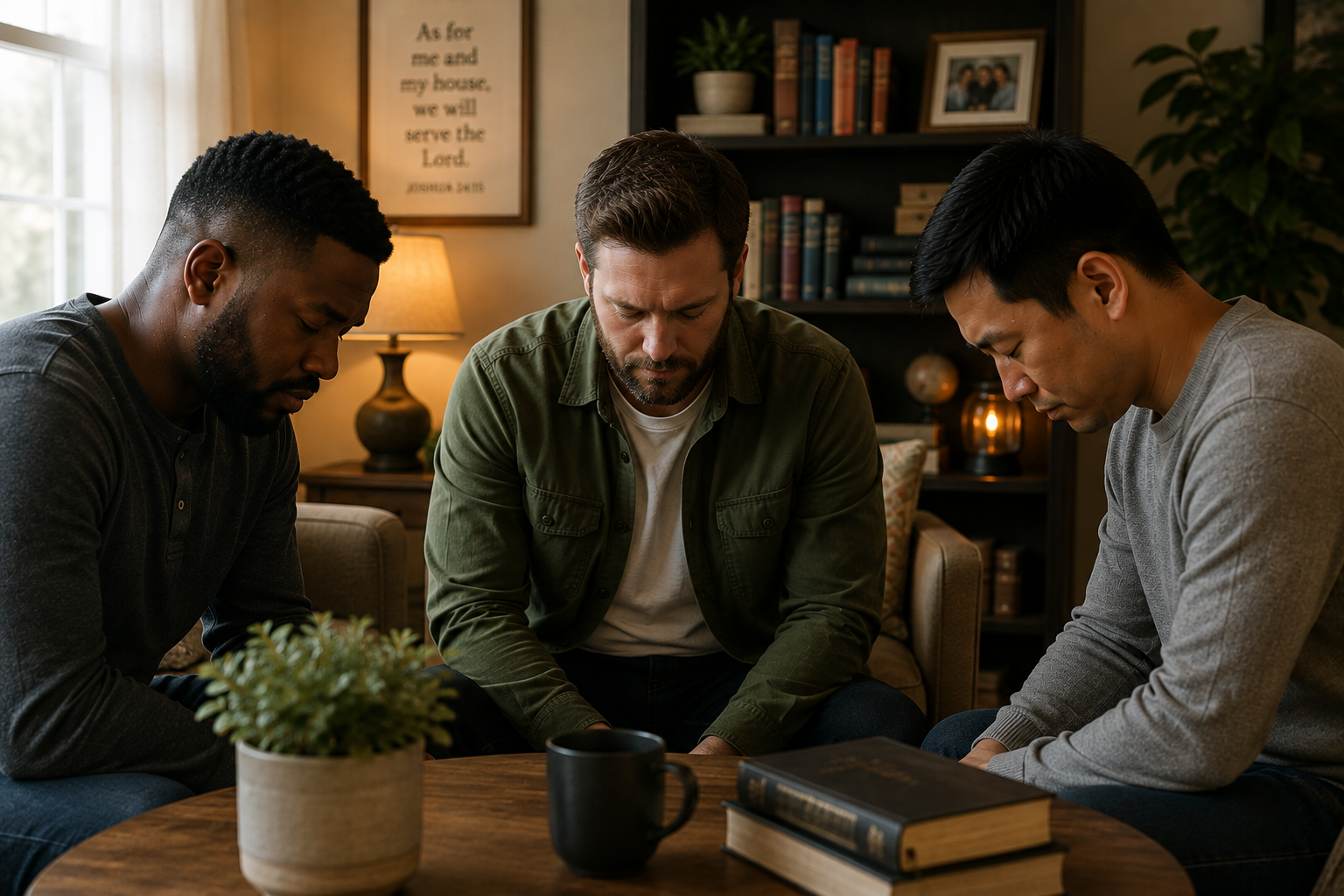
I met with a good friend today to spend some time in prayer.
I’m blessed to have two guys I meet with on different days each week to share and pray together—a rhythm I’ve enjoyed for several years. Today, though, we were shifting our rhythm and engaging in prayer a little differently, so we began by discussing a framework for our time together.
As we talked and then moved into prayer, I was struck by the necessity of that initial conversation. We needed to discuss how we could pray so that we could pray well together.
And that got me thinking about something else that seems fairly common throughout the American Church: when we gather to pray as a group, we usually spend most of our time talking and then wrap up with a few minutes of prayer in response to our conversation.
In at least one nationwide prayer gathering in which I have participated, this was actually the expressed purpose and intent—a desire both to pray together and to strengthen relationship bonds that stretch across hundreds of miles.
That is a good thing, and it definitely has its place. Relationship is a significant part of spiritual community.
But I’m also increasingly aware of how little we pray as a people.
I don’t mean that as a criticism, but simply as an acknowledgement of our average experience. Barna Group and the National Day of Prayer Task Force have reported that the average Christian spends about one minute per day in prayer.
Corporate prayer gatherings obviously last longer, but even there, the common experience is often mostly conversation punctuated by perhaps 15 minutes of prayer—usually with each participant being given an opportunity to pray once.
I recognize that this isn’t everyone’s experience. Across the United States there are many beautiful prayer ministries where people engage deeply in prayer for extended periods of time, both personally and corporately.
It’s just not the average Christian experience.
Meanwhile, the groundbreaking study Miraculous Movements by Jerry Trousdale reveals a very different trend in the non-Western world. Trousdale reports that in regions where the Church is growing most rapidly—even sustaining exponential growth—the average Christian prays for about two hours a day.
Two hours is a long way from one minute.
I’m sure most Americans will read that and feel pretty intimidated. I know I do. But then I think back to my prayer meeting with my friend this morning.
We had about 40 minutes available to pray together, and when our time was up, we both felt like we had just gotten started. Neither of us felt like that much time had elapsed. We could have — and would have loved to have — spent much more time in continued prayer.
I think part of the reason we find extended prayer intimidating, and part of the reason our corporate prayer gatherings struggle to spend more time in actual prayer, is that we aren’t familiar with a functional structure for doing it.
We anticipate that we’re going to get together, bow our heads, and somehow just know how we’re going to pray, who’s going to say what, how long we’re going to pray about a given topic, and how long the whole thing is going to last.
But then we get together and it’s awkward.
We haven’t discussed any of those things, and we don’t exactly know how to do more than what we already know. So we spend the bulk of our time sharing, then wrap things up with a quick prayer and a reflection on the fact that, after all, God was with us and listening to our conversation anyway.
In his beautiful work Moving Mountains, John Eldredge reflects on God’s desire for us to grow and mature in prayer—to increase in depth and partnership with Him in bringing to reality, “Thy kingdom come and Thy will be done, on earth as it is in heaven.”
He uses the analogy of a father and child. A father initially dresses his child completely. But over time, his desire is for that child to learn to dress himself. In the same way, our Heavenly Father desires for us to grow in taking increasing responsibility in our partnership with Him.
I don’t think most of us have really grasped this.
I think we expect prayer to grow and deepen on its own. We expect it to automatically reflect however long we’ve been following Jesus.
We don’t expect prayer to be a skill that has to be developed. We don’t expect it to need to be taught—and once taught, practiced. We don’t expect it to need to be trained.
Back around 1992, my youth pastor invited me to join him on Sunday mornings before church—just to pray. I was in seventh or eighth grade. He and I would meet for about 45 minutes before Sunday School, and in a way that nobody ever had before, he taught me how to pray. When he moved on, another leader from our church took over with the youth. He and I continued the same practice of meeting before Sunday School, and he continued to teach me.
It is a skill that has paid dividends throughout the 30-plus years since, but I never realized how rare a gift it was. To this day, when I gather with other leaders to organize prayer meetings—and especially when I am discipling younger men—I use the same basic framework my youth pastors taught me.
Not because it is holy or because it is “the right way to pray,” but simply because it provides a structure: a framework for us to know what to expect and how we are going to pray together.
I’d like to share it with you now.
I imagine that some of you will have heard something like this before. At its core, it follows the acronym ACTS, although I like to include a pause before and after the four sections. It looks like this:
- Pause
Take a moment, perhaps five minutes, to simply be still. We quiet our hearts, shut down the noise of the world inside our minds, and orient ourselves toward Jesus.
This is the posture of Psalm 46:10: “Be still, and know that I am God.” It’s the practice of setting our minds on things above (Colossians 3:1–2) and withdrawing to quiet places to pray, as Jesus Himself did (Luke 5:16).
- Adoration
Each of us takes a turn speaking out loud to the Godhead, saying what we love about Him. We reflect on His goodness, greatness, grace, and glory.
Sometimes, after someone else prays, we may want to pray again—either because something else has come to mind or because we want to reflect on what someone else has prayed. That’s fine. There is space for that.
- Confession
Confession simply means “agreeing with,” so we take some time together to agree with God.
We begin by acknowledging the difference between ourselves and Him, and that naturally leads us into a time of self-examination. Depending on the level of safety we feel within the group, we may pray more generally or more specifically. We confess our need for Him, our dependence on Him, and the ways we have not walked with Him as we should.
Again, we make space for everyone to have a turn. But if someone wants to pray multiple times, we make room for that too.
- Thanksgiving
First John 1:9 tells us that if we confess our sins, He is faithful and just to forgive us our sins and cleanse us from all unrighteousness.
What a gift!
Having seen ourselves in contrast to His greatness, we now turn and thank Him for the rich blessings He has poured into our lives.
A helpful framework here is for each person to name one thing and thank God for it, then let someone else pray. This makes room for everyone to take multiple, shorter turns rather than feeling like each person has to come up with one long prayer.
- Supplication
Finally, we bring our burdens to God.
Again, it can be helpful for each person to have a turn praying about one specific thing and then pause.
Another person in the group can agree with that first prayer before moving on to the next request. Agreement can be as simple as: “Yes, Lord. I agree with this request. Would You please do it?” Or someone may feel led to pray additional thoughts about the matter. There’s room for that too.
- Pause
After everyone has had time to pray through supplication, it’s good to pause once more. This time, we are simply listening. Is the Holy Spirit moving? Is He bringing something specific to mind? Is there something He wants to say or draw our attention toward? We are just making space for God to respond in the stillness.
After a few minutes of being still and listening, we conclude with an “Amen”—the Hebrew word meaning, essentially, “Let it be so.”
Again, this is not a theology of prayer, and it’s definitely not the only way to pray. It is simply a framework I have found helpful. There are many other good frameworks for prayer, this is just one that has served me well.
And if this is new to you, I would encourage you to start small.
It’s much easier to add a 30-second practice to your day than a 15-minute one.
Begin with just the pause, find a moment somewhere in your day to stop, become still, and orient yourself toward Christ. As that becomes natural, and as you begin to hunger for more, gradually add the other elements, one at a time. I think you may be surprised by how natural the progression feels—and how easily you can move through it once you have a framework to follow.
Let me conclude with this:
If you’re wondering how you can deepen your Christian faith and grow in fellowship with God—and especially if you’re wondering how to take a concrete step in that direction—here’s your sign.
Just start.
You may be surprised by how quickly a few minutes of intentional prayer becomes something you look forward to, and you may be even more surprised by the way God meets you there – whether alone or in the company of others.