
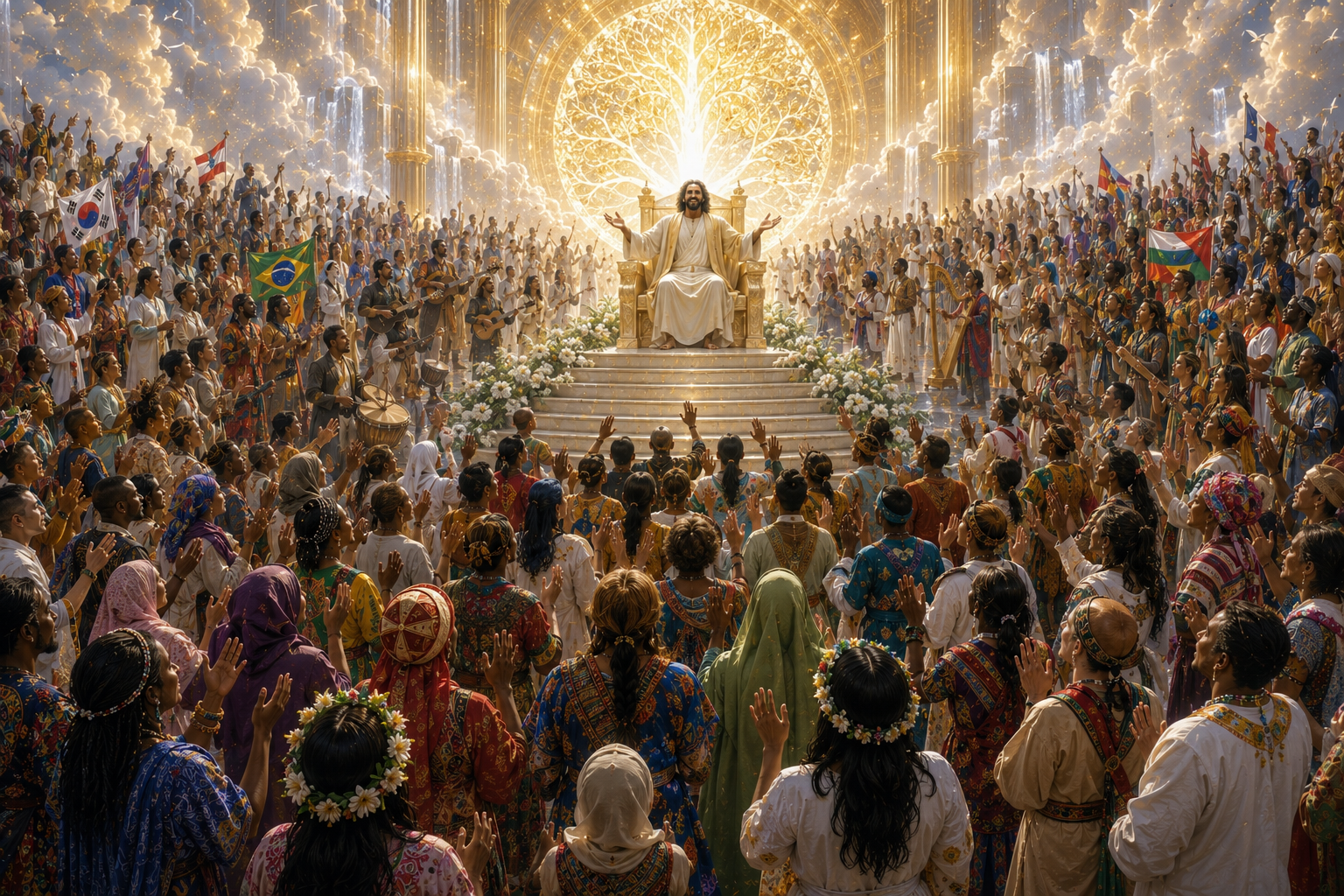
Every Tribe, Tongue, and Nation
Sometimes I wonder if we’ve heard the phrase “every tribe, tongue, and nation” so often that we’ve stopped hearing it altogether.
It’s one of those phrases Christians quote almost reflexively. We use it when we talk about missions. We use it when we celebrate the spread of the Gospel. We use it as shorthand for God’s heart for the nations.
We know the words.
But have we stopped to consider what they actually mean?
This vision is woven throughout Scripture. From God’s promise to bless all the families of the earth through Abraham, to Jesus’ command to make disciples of all nations, to the picture John gives us in Revelation, the story has always been moving toward the same destination.
In Revelation 7:9, John writes:
“After this I looked, and behold, a great multitude that no one could number, from every nation, from all tribes and peoples and languages, standing before the throne and before the Lamb…”
It’s one of the most beautiful scenes in all of Scripture.
But it is more than beautiful.
It is revealing.
It tells us something about what Jesus values.
Notice the language. Elsewhere, Jesus speaks of all nations—panta ta ethne (Matthew 24:14; Matthew 28:19). The Greek word ethne is where we derive our word ethnicity. Revelation goes even further. John doesn’t simply say “all nations.” He says every nation, tribe, people, and language.
That repetition isn’t accidental.
The picture becomes increasingly specific.
Different languages.
Different peoples.
Different cultures.
Different ethnic identities.
Not just some of them.
Not the cultures we happen to admire.
Not the ones most like our own.
All of them.
Jesus Christ desires worship from every tribe, every tongue, every people, and every nation.
That doesn’t mean every culture is morally perfect. Every culture bears the corruption of sin and must be transformed by the Gospel.
But it does mean this:
There are no throw-away cultures.
The goal of redemption is not cultural homogenization. The goal is redeemed humanity, bringing every distinct people into joyful submission to Christ while preserving the astonishing diversity He Himself created.
That has profound implications.
It’s easy to affirm Revelation 7 in theory while resisting it in practice.
Around the world, hostility toward minority peoples is increasing, while at the same time millions have been displaced from their homes through war, persecution, and political upheaval. According to the UN Refugee Agency, nearly 118 million people are currently living in forced displacement.
There is much to say about how Christians should respond to refugees and immigrants.
But before we point our attention outward, perhaps we should first examine how we treat the minority peoples who already share our neighborhoods, our workplaces, and our churches.
Many of us have lived together so long that we’ve forgotten something obvious.
Even within America, we are representatives of different tribes, tongues, peoples, and nations.
African American, Latin American, Asian American, Native American, and more.
These are not merely individuals who happen to have different skin tones.
They are representatives of cultures that, according to John’s vision, will one day stand before the throne of Christ, bringing worship that reflects the unique beauty of the peoples God created.
That should matter to us because it clearly matters to Him.
Think about it.
If cultural distinction were insignificant in God’s kingdom, why would Revelation emphasize language at all?
Language is one of the deepest markers of culture. It shapes stories, traditions, relationships, humor, poetry, worship, and identity.
Wouldn’t heaven be simpler if everyone worshiped in the same language?
Wouldn’t it be less chaotic if everyone sang the same songs in the same style?
Perhaps English?
But that is not the kingdom Christ is building.
Scripture presents something far more beautiful.
The throne of Christ surrounded by simultaneous worship in every language.
Not despite those differences.
Because of them.
The diversity of redeemed humanity is not an obstacle to overcome. It is part of the glory Christ delights to receive.
And this is where I believe many American Christians find themselves in tension with the kingdom of God.
For generations, we’ve celebrated the ideal of the “melting pot.” At its best, it reflects a desire for unity. But too often it has meant something else.
If you want to belong, become like us.
Speak like us.
Worship like us.
Adopt our customs.
Leave behind the parts of your culture that make us uncomfortable.
We rarely say those words out loud.
But our expectations often reveal them.
When believers from minority cultures worship differently, communicate differently, celebrate differently, or simply carry themselves differently than White American culture expects, how often do we become irritated?
How often do we quietly conclude that they need to become more like us?
Even within the Church, there is growing pressure to define what a “real American” looks like, and increasingly, what a “real Christian” looks like. Too often those two identities become so intertwined that they are difficult to separate.
That should alarm us.
Because the kingdom of Christ has never been defined by one national culture.
White American culture is not the standard by which every other culture should be measured, nor is any other culture.
Christ is the standard.
The Gospel confronts every culture.
It exposes every culture’s sin.
And it redeems every culture without demanding that it become another one.
If we value what Christ values, then we cannot insist that other peoples become culturally like us before they truly belong.
We should long instead to see Christ honored within every culture, as each people brings the unique gifts God has woven into them back to their Creator in worship.
Which brings us to a question that is difficult, but necessary.
Which vision shapes us more?
The vision of America?
Or the vision of Revelation?
If our definition of a “good American” carries more emotional weight than Christ’s desire to receive worship from every tribe, tongue, people, and nation, then our patriotism has become disordered.
If our cultural preferences cause us to resent or diminish those whose cultures differ from our own, then we have elevated our culture above Christ’s kingdom.
If we demand cultural conformity where Christ has not, then we are asking people to bow first to our culture before bowing to our King.
That is not discipleship.
It is a subtle form of idolatry.
Our identity as Americans—valuable though it may be—must always remain secondary to our identity in Christ.
Our allegiance to His kingdom must always outrank our allegiance to our nation.
So let me leave you with one final question.
If you are part of America’s majority culture, do your African American, Latino, Asian American, Native American, and other minority neighbors experience you as someone who genuinely celebrates them as fellow image-bearers whose cultures will one day be represented around the throne of Christ?
Or do they merely feel tolerated?
Do they sense that they are welcomed as they are, or that acceptance depends on how closely they resemble the majority culture?
The answer to that question says far more about our theology than we might like to admit.
Because if Revelation 7 is the future Christ is preparing, then His Church should already be learning to live that reality now.
Perhaps before we turn our eyes toward reaching every tribe, tongue, and nation across the world, we should first ask whether we have learned to love the tribes, tongues, and nations God has already placed beside us.
The kingdom is coming.
The question is whether our hearts are being shaped by it—or by something else.